He was sitting at the edge of a parking lot behind a strip mall on Coors Boulevard when Joanna Reyes first noticed him. She assumed he was resting. She drove past.
Something made her turn around.
“I don’t know what it was,” she said. “I just couldn’t keep going.”
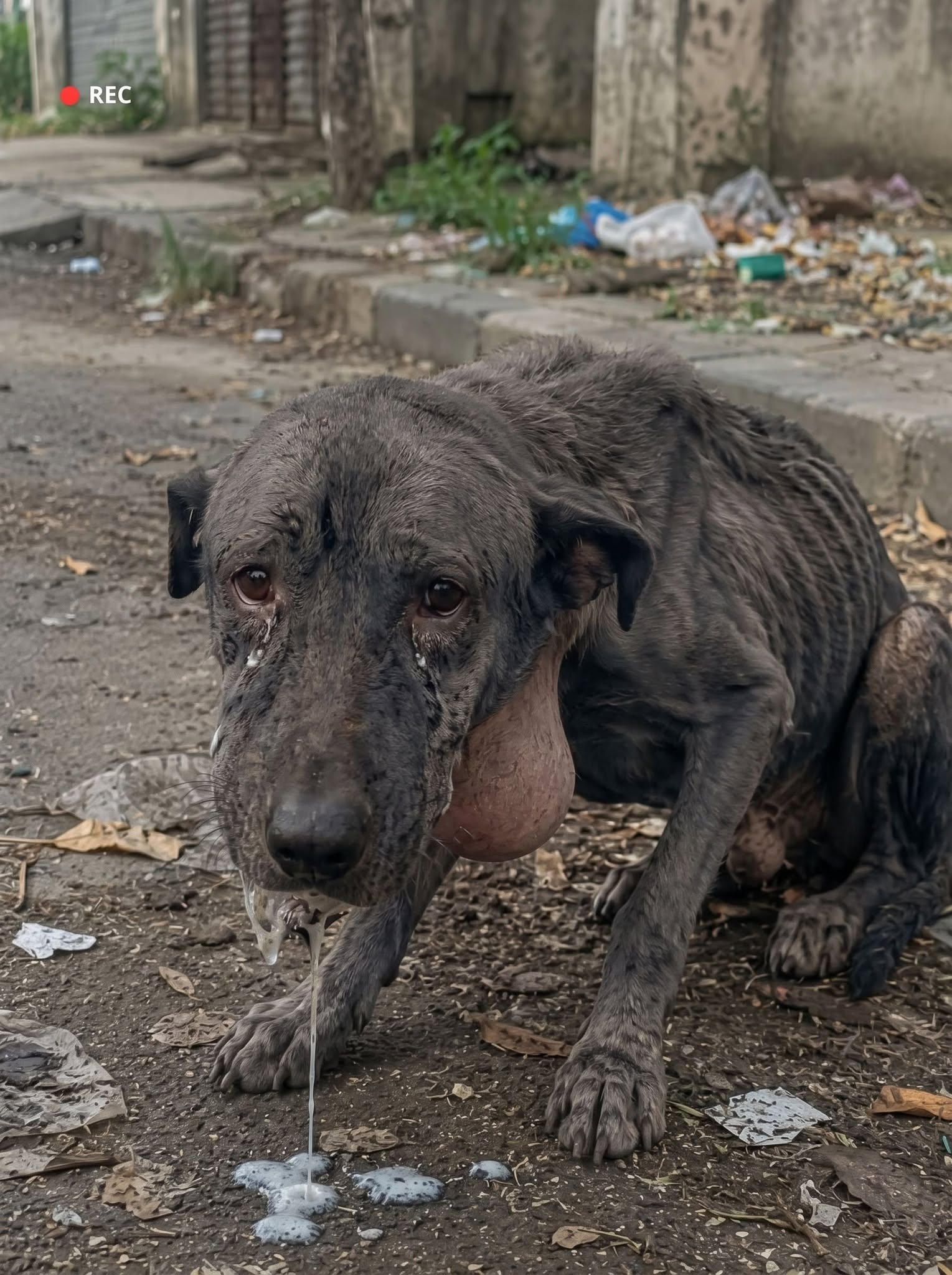
When she got out of her car and walked closer, what she found stopped her where she stood. The dog — small, male, no collar — was almost completely without fur, his skin thickened and inflamed from what appeared to be advanced untreated mange. His ribs and spine were plainly visible through the damaged skin. At the left side of his neck, a large mass protruded visibly, stretching the skin taut. Foam had gathered at the corners of his mouth. Tears tracked steadily down both sides of his face.
He did not run. He did not make a sound. He sat and looked at her.
“I didn’t know what to do,” Reyes said. “I just knew I couldn’t leave.”
She called Albuquerque Animal Welfare at 4:17 p.m. She stayed with the dog until officers arrived thirty minutes later, sitting on the asphalt beside him, not touching him, talking quietly.
Responding officer Chris Navarro said the dog’s condition was among the most severe he had encountered outside of deliberate cruelty cases. “Everything was happening at once,” Navarro said. “The skin disease, the mass, the neurological signs — the foaming, the tearing. This animal had been suffering for a very long time with no intervention.”
The dog — named Coors by shelter staff, after the boulevard where he was found — was transported directly to an emergency veterinary facility. Dr. Sandra Park, who led his assessment, described a patient presenting with simultaneous and compounding conditions: severe demodectic mange covering more than seventy percent of his body surface, extreme malnourishment with associated organ stress, and a cervical mass — a large growth at the throat — requiring immediate imaging to determine its nature and operability.
“The foaming at the mouth indicated significant distress, possibly related to the pressure the mass was placing on surrounding structures,” Park said. “The tear production was consistent with pain response. He was not simply uncomfortable. He was in crisis.”
Coors was stabilized overnight with IV fluids, pain management, and nutritional support. Imaging conducted the following morning revealed the cervical mass to be a large benign cyst — operable, Park said, once the patient was strong enough to withstand anesthesia. The mange, while extensive, was treatable with a sustained medication protocol.
“The prognosis changed significantly once we had the imaging back,” Park said. “He has a path forward. It will be long. But it exists.”
Albuquerque Animal Welfare has opened a neglect investigation. No owner has come forward. The department confirmed that no prior reports had been filed regarding the dog, meaning he had been in his deteriorating condition — visible, in a public parking lot — without anyone calling for help.
“That’s the part that’s hard to sit with,” said shelter director Monica Ortega. “He was out there. People saw him. And it took one person deciding to turn around.”
As of Friday, Coors had completed his first week of mange treatment. He had gained nearly three pounds. The surgery to remove the cyst has been scheduled for later this month, pending continued improvement in his baseline health.
Reyes has called the shelter every day since the rescue. Staff told her that Coors has begun approaching his kennel door when he hears unfamiliar voices — cautiously, ears forward, still deciding.
“He’s starting to believe it,” Ortega said. “That’s what it looks like when they start to believe things might be different. You can see it — just a little — in how they hold themselves.”