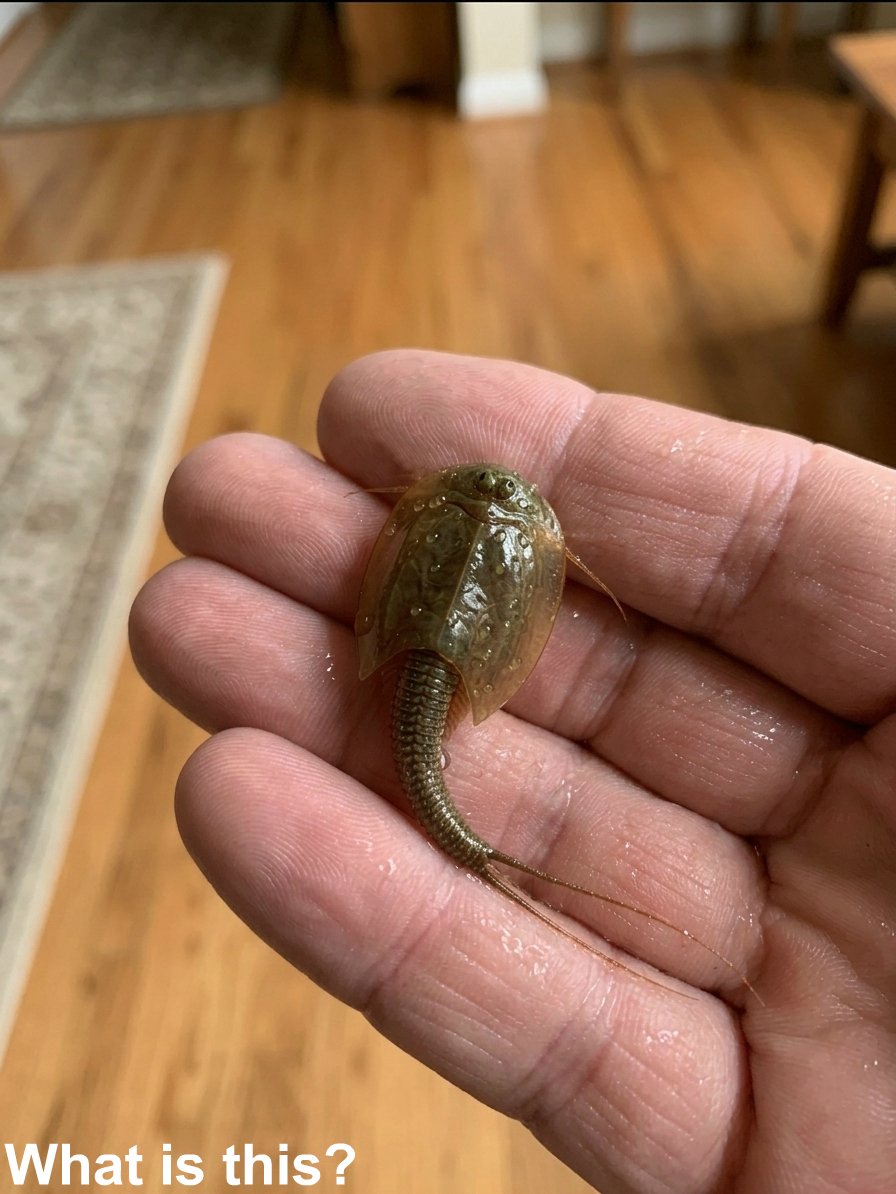
After a relentless storm turned neighborhood drainage ditches into rushing rivers, one homeowner discovered a creature that seemed to belong in a nightmare. In a stagnant pool left behind by the floodwaters, a frantic, rhythmic movement caught their eye: an olive-brown, alien-looking shape with a shield-like carapace and a long, segmented tail. Initially feared to be a venomous parasite or a mutated insect, the specimen was captured in a glass jar for closer inspection, revealing three eerie eyes peering back from what felt like another dimension.
However, what was first perceived as a “monster” turned out to be one of the most successful biological designs in Earth’s history. The creature was identified as a Triops, a genus of small crustaceans famously known as “living fossils.” These remarkable beings belong to a lineage stretching back nearly 300 million years, meaning their ancestors were swimming in puddles during the Carboniferous and Permian periods, long before the first dinosaurs ever thundered across the prehistoric plains.
The evolutionary resilience of the Triops is staggering; they remained virtually unchanged while the mighty Tyrannosaurus rex rose to dominance and eventually vanished into the fossil record. Having survived the “Great Dying”—the Permian-Triassic extinction event that wiped out 96% of marine life—as well as the asteroid that ended the age of giants, these tiny survivors offer a profound sense of perspective. They have witnessed the drift of continents and the birth of the human race from the humble vantage point of seasonal, muddy puddles.
The secret to their incredible longevity lies in a biological marvel known as “diapause,” a state where their “resting eggs” can lie dormant in parched, sun-baked soil for decades. These nearly indestructible cysts wait with infinite patience for the right conditions to return, triggered by the very storms we often view as a nuisance. This discovery serves as a humbling reminder that the prehistoric past is never truly gone; sometimes, a 300-million-year-old miracle is simply waiting in a suburban ditch for a bit of rain and a curious eye.