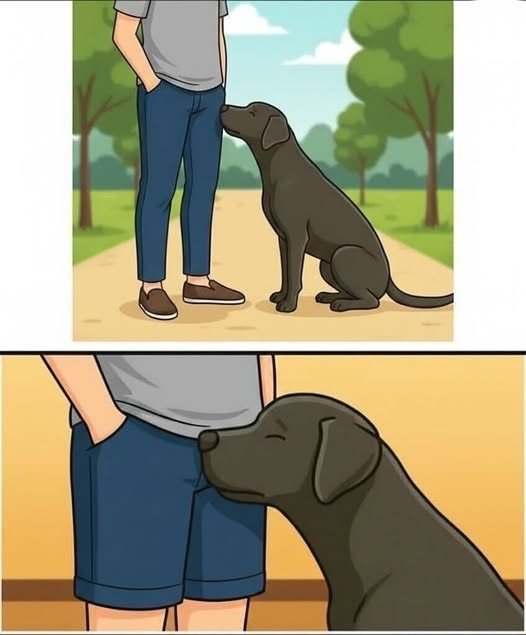
To exist as a dog is to navigate a world constructed entirely of invisible chemical architecture. While humans experience the universe through a kaleidoscope of colors and structured language, a dog perceives reality as a complex and swirling map of scents. Their noses are not merely sensory organs; they are highly sophisticated biological laboratories capable of deconstructing the very essence of a person. What we often perceive as a mortifying breach of social etiquette is, in the eyes of a dog, a vital and respectful search for the truth about who we are and how we feel.
The biological catalyst for this behavior lies in the apocrine sweat glands, which are concentrated in the human groin and underarm areas. These glands serve as the primary broadcasters of pheromones, which act as the chemical fingerprint of our identity. When a dog leans in to sniff these areas, they are performing a high-speed download of your biological data. In a matter of seconds, a dog can determine your age, gender, health status, and even specific stages of your hormonal cycle. For a canine, this is the equivalent of a firm handshake or a thorough exchange of business cards.
Beyond simple identification, the power of the canine nose allows dogs to act as emotional mirrors for their owners. They are capable of detecting subtle shifts in body chemistry that occur when we experience stress, fear, or joy. When we are anxious, our bodies release cortisol and adrenaline—chemicals that a dog can sense long before our heart rate noticeably increases. This is why a dog will often lean against your legs or rest its head on your lap during a difficult day even if you haven’t uttered a word. They are reading the literal air for the chemical markers of your distress with an accuracy humans cannot match.
This extraordinary sensitivity is the foundation for the life-saving work performed by medical alert and service dogs. These animals are trained to recognize the specific chemical shifts that precede a seizure, a drop in blood sugar, or a spike in heart rate. The very same instincts that drive a household pet to sniff a guest’s leg are the ones that allow a service dog to save a life. Ultimately, to be sniffed by a dog is to be known at a level that transcends words; it is a gesture of unwavering attention and loyalty from a creature whose devotion is based on the very essence of your being.