The corridors of power in Washington and the sacred halls of the Vatican are currently locked in a historic and rapidly escalating confrontation that threatens to redefine the relationship between church and state. What began as a series of sharp rhetorical exchanges has transformed into a profound ideological war, centered on the fundamental question of who holds the ultimate authority to dictate the moral direction of a nation. At the heart of this storm is a direct clash between Donald Trump and Pope Leo XIV, a conflict that has been pushed to a breaking point by a bombshell intervention from JD Vance, signaling a struggle for the very soul of leadership.
The friction ignited when Donald Trump launched a series of blistering critiques against Pope Leo XIV, labeling the pontiff as “weak on crime” and questioning his competence regarding global foreign policy, specifically his opposition to escalating military conflicts in the Middle East. The rhetoric took a turn for the surreal when Trump shared a controversial AI-generated image portraying himself in a Christ-like role, a move that sent shockwaves through religious communities worldwide. While some supporters dismissed the image as political satire, critics and religious scholars viewed it as a provocative blurring of the lines between secular power and divine symbolism.
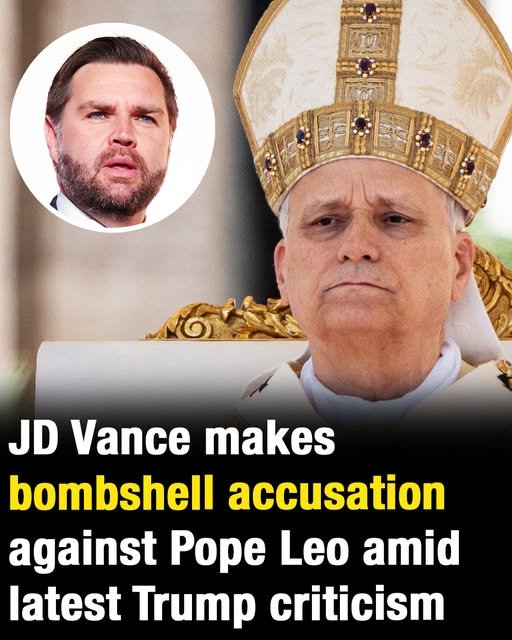
The firestorm reached a new level of intensity with the public comments of JD Vance, a high-profile Catholic convert whose words carry unique weight within the religious community. Vance publicly challenged the Pope’s authority to weigh in on specific policy decisions, suggesting that the Vatican should stick to matters of abstract morality and leave the actual governance of the world to elected officials. This ideological declaration of independence for the state draws a hard line in the sand, suggesting that religious influence has no place in the Situation Room and highlighting the centuries-old boundary between moral authority and political control.
From the administration’s perspective, the logic is one of national interest, arguing that the complexities of military strategy must remain in the hands of those directly accountable to voters. Conversely, the Catholic Church maintains that the Pope’s role is to act as a moral check on the impulses of political leaders, defending human dignity and peace regardless of political convenience. As this “unholy war” continues, it signals a deepening schism in the Western world where ancient institutions are no longer immune to the polarized vitriol of modern politics, leaving the global community to wonder if political decisions can ever truly be separated from their moral implications.