It started with a trunk.
Tychon, a seven-month-old Asian elephant born without functional vision, had been resting on a bed of dry hay inside the sanctuary barn when Bruno wandered in through the open side door. Bruno — a mid-sized mixed-breed dog with a torn left ear and a lattice of old scars across his muzzle — was a rescue himself, brought to the property two years ago by a sanctuary staffer after being found abandoned near a rural highway in Alabama.
No one introduced them. No one engineered the moment. A caretaker on the other side of the barn looked up from her work and saw it happening on its own.
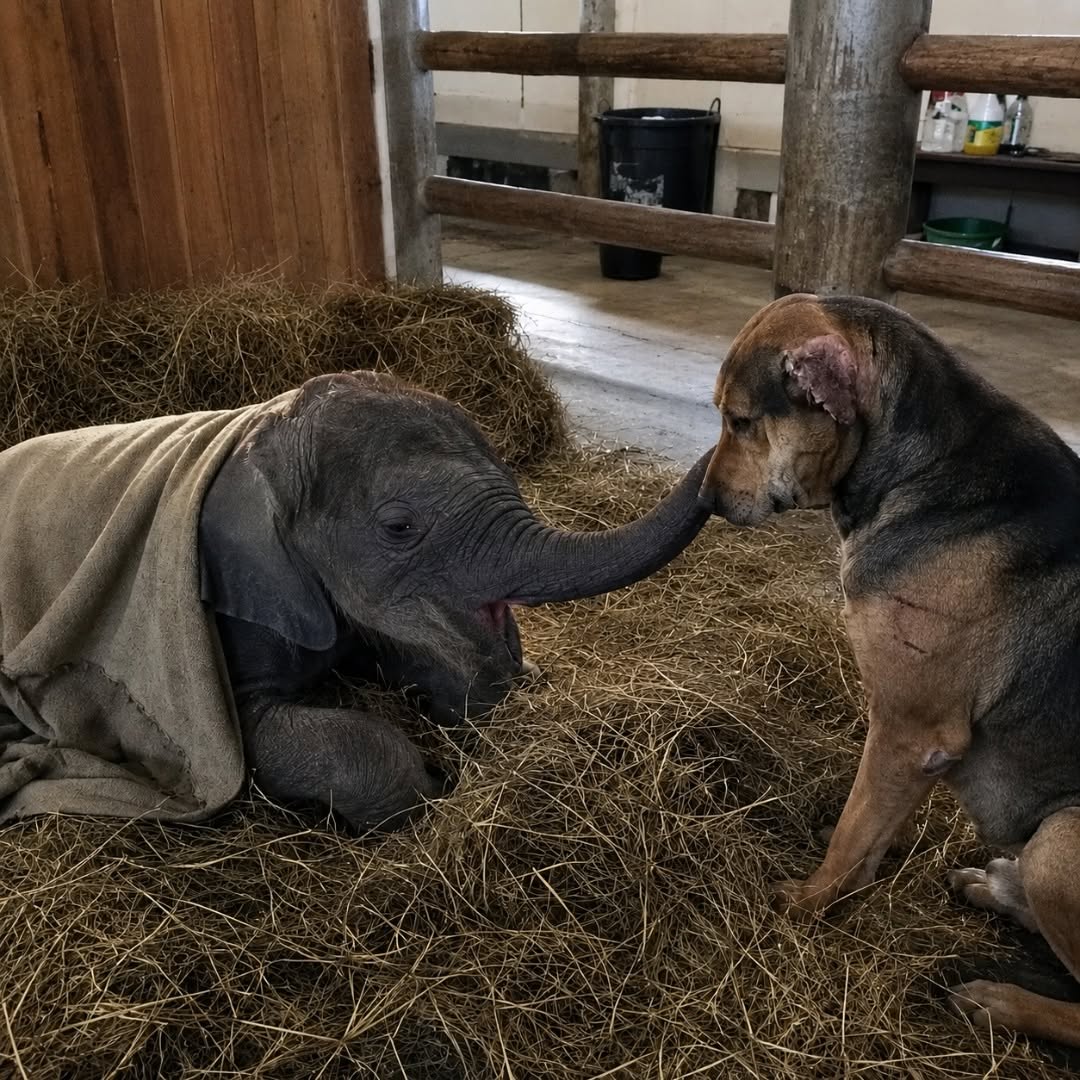
Tychon had lifted his trunk — slowly, with the particular deliberateness of a young animal still learning to navigate a world he cannot see — and touched it to Bruno’s nose. Bruno did not flinch. He sat. He blinked. He stayed.
“I didn’t move,” said caretaker Alison Marsh, who witnessed the exchange. “I was afraid if I moved, it would break something.”
Tychon arrived at Wildwood Animal Sanctuary in Hohenwald three months ago, transferred from a zoo facility in Ohio after staff there determined that his congenital blindness made integration with the facility’s existing herd unsafe for both Tychon and the other animals. He was underweight, easily startled, and, according to sanctuary director Paul Greer, profoundly disoriented in his new environment.
“Blind elephants rely enormously on sound and touch and the presence of familiar individuals,” Greer said. “He came here knowing no one. That’s an incredibly isolating experience for a species that is fundamentally social.”
Bruno, by contrast, had spent two years becoming a fixture of the property — calm, undemanding, comfortable around large animals in a way that sanctuary staff attributed to simple temperament. He had never shown particular interest in Tychon before that afternoon.
Since the encounter in the barn, the two have been observed together on eleven separate occasions over a three-week period. Tychon has begun moving through the barn with noticeably less hesitation on days when Bruno is present. Bruno, for his part, appears to have adopted a loose routine of positioning himself within trunk-reach of the young elephant during rest periods.
“We’re not claiming they’ve formed a bond in any scientifically rigorous sense,” Greer said carefully. “What we can say is that Tychon’s stress indicators — vocalization, body tension, repetitive movement — are measurably lower when Bruno is nearby. Whatever is happening between them, it’s doing something.”
A short video clip captured by Marsh on her phone, showing Tychon’s trunk reaching out to find Bruno’s face in the quiet of the barn, was shared to the sanctuary’s social media accounts last Friday. By Monday morning it had been viewed more than three million times.
The sanctuary has been fielding donation inquiries since the video circulated. Greer said the funds will go toward Tychon’s long-term care, which includes specialized veterinary oversight and the gradual, carefully managed introduction to other elephants at the facility.
Bruno, for his part, remains unimpressed by the attention. He was asleep in the barn when a reporter visited Wednesday afternoon — positioned, without apparent intention, exactly within trunk-reach of where Tychon likes to rest.
“He doesn’t know he’s famous,” Marsh said. “He just knows where he wants to be.”