The kennel was clean. The floor was dry. There was food in the bowl and water beside it. By every measurable standard, the dog was safe.
He was pressed into the corner anyway, shaking.
Patches — a white mixed-breed dog with brown markings around both eyes, estimated to be around two years old — arrived at Austin Animal Center last Monday after being picked up as a stray near a construction site in the East Cesar Chavez neighborhood. He had no microchip. No collar. No one came forward to claim him in the 72-hour hold period.
By Tuesday morning, shelter staff had begun documenting something they don’t often see so consistently or so visibly: the dog was crying.
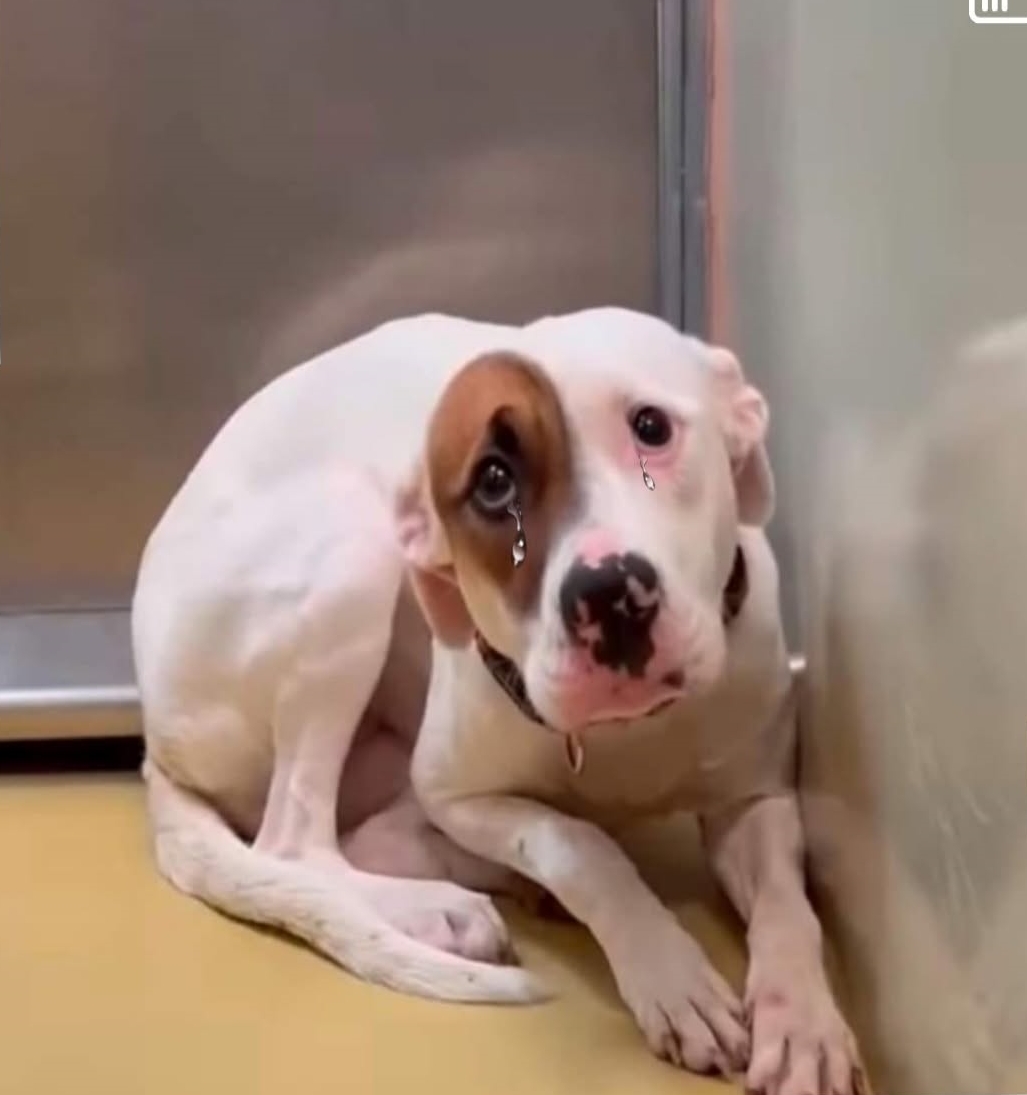
Not vocalizing. Not whimpering or barking. Crying — large, slow tears rolling steadily from both eyes, tracking down the sides of his face, his body trembling in small continuous waves against the corner wall. His ears twitched at sounds down the hallway. His eyes blinked slowly, heavily, as though each blink cost something.
“I’ve worked here six years,” said kennel technician Rosa Alvarez. “I’ve seen a lot of dogs come through scared. But this was different. He wasn’t reacting to anything specific. He was just — grief-stricken. That’s the only word I have for it.”
Shelter behaviorist Dr. Neil Hoang assessed Patches on his second day. His notes describe a dog exhibiting acute stress response consistent with sudden environmental displacement — a clinical way of saying that Patches, wherever he had come from, had not been prepared for this.
“Some dogs adapt quickly to a shelter environment,” Hoang said. “Others experience it as genuinely traumatic. The noise, the smells, the complete absence of anything familiar — for a dog who was previously in a stable home environment, that loss registers. We see it in their behavior. In his case, we were seeing it very literally on his face.”
Staff began a modified interaction protocol — short, quiet visits, no direct eye contact, food offered by hand at a distance. Volunteers were asked to sit near his kennel without attempting to touch him, simply to acclimatize him to calm human presence.
Progress was slow and then, on the fourth day, it wasn’t.
Alvarez was sitting outside his kennel on Thursday afternoon, reading, when she felt something press lightly against her hand through the kennel bars. She looked down. Patches had moved from the corner — the first time since his arrival — and placed his nose against her fingers.
“I didn’t move,” she said. “I just let him stay there as long as he wanted.”
He stayed for eleven minutes.
A photograph taken by a colleague that afternoon — Patches at the kennel bars, nose touching Alvarez’s hand, tear streaks still visible on his white fur — was posted to Austin Animal Center’s social media accounts the following morning. Within 48 hours it had been shared more than 90,000 times. The shelter received over 600 adoption inquiries.
As of Friday, Patches was no longer spending his days in the corner. He moves to the kennel door when Alvarez arrives for her shift. He has begun eating without waiting for staff to leave the room. The trembling, shelter staff say, has largely stopped.
“He just needed to know that someone was going to keep showing up,” Alvarez said. “That’s all it was. Someone who kept coming back.”
Patches is now available for adoption. The shelter asks that prospective adopters have a quiet home environment and patience for a dog still learning that safe and safety can mean the same thing.