The bread had been there for several minutes before he touched it.
He lay pressed against the back wall of an alley off Government Street, a thin, dark-coated dog of indeterminate breed, his body curved tightly into the gap between two buildings. When the loaf landed on the pavement beside him — tossed by the owner of a neighboring shop who had spotted him from the doorway — his first reaction was to flinch. His second was to pull it toward him with both paws and fold his body around it.
He did not eat. Not right away. He held it.
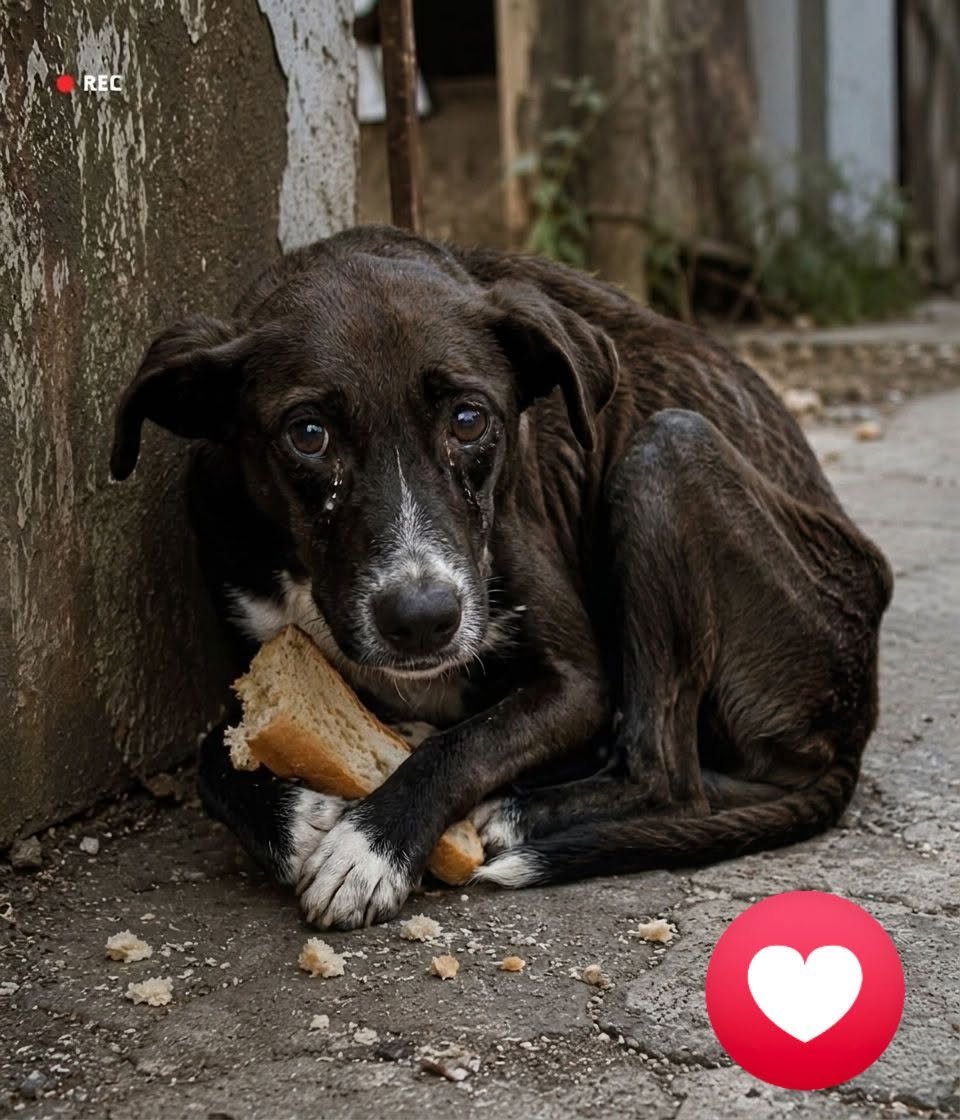
“He just kept it against his chest,” said Felix Broussard, the shop owner who made the call to Baton Rouge Animal Control shortly after. “Like he was afraid someone was going to take it. He’d look at it, then look up at the alley, then back down. He couldn’t do both things at once — eat and feel safe. So he just held on.”
Broussard had first noticed the dog earlier that afternoon — a still shape in the shadows, back to the wall, watching the lane with the particular alertness of an animal that has learned the hard way that threats come without warning. He had brought out the bread on instinct. He had not expected to find himself still watching twenty minutes later, unable to go back inside.
Animal control officers arrived to find the dog in the same position. He did not attempt to flee. He lifted his head and watched them approach — slowly, without the energy to run, without the trust to stay still without watching.
His hind legs trembled when he finally stood.
The dog — named Levee by shelter staff, a reference to the flooding that officers believe separated him from his home — was transported to the Baton Rouge Animal Control facility for assessment. Dr. Christine Arceneaux, who examined him on intake, said his physical condition told a story of weeks on the street, not days.
“The muscle loss in the hindquarters, the coat condition, the wear on his paw pads — this dog had been covering ground for a long time,” Arceneaux said. “He wasn’t lost recently. He had been surviving for a while, and he had reached the end of what surviving looked like.”
Shelter behaviorist Dr. Marcus Tran noted something in Levee’s intake assessment that he described as distinct from typical stray behavior. “He wasn’t feral,” Tran said. “Feral dogs don’t make eye contact the way he did. He was looking at people the way a dog looks at people when he used to live with them. He remembered what humans were supposed to be.”
That observation aligned with what officers found when they canvassed the neighborhood. Following the severe flooding that struck the parish six weeks earlier — which displaced dozens of families and sent animals scattering across the city — a resident on nearby Myrtle Street confirmed that a dog matching Levee’s description had lived on her block. The family, she said, had evacuated quickly and the dog had bolted in the chaos.
Efforts to locate the original owner are ongoing. Animal control has made contact with flood relief organizations coordinating pet reunification in the affected neighborhoods.
In the meantime, Levee has been placed in a foster home. His foster carer, a retired nurse named Dorothy Carr, reported that he spent his first evening pressed against the wall beside the couch — back covered, eyes on the room — before falling asleep on the floor sometime after midnight.
By the second morning, he had moved to the couch itself.
“He’s starting to remember,” Carr said. “You can see it. The way he looks at the door when I come home. The way he’s eating now — like he believes there’s going to be more.”
Broussard visited Levee at the foster home last weekend. He brought bread.
This time, Levee ate it right away.